



|
|
Rubellite
"The Red Tourmaline (Rubellite) is
occasionally so nearly ruby-red in colour as to
necessitate care".
Augusto Castellani (1829-1914), Gems: Notes
and Extracts
|
|
 |
|
|
Peter the
Great (1672-1725) reportedly
commissioned many items of 'Ruby'
jewellery for the Russian Imperial
Court that were later discovered to
be Rubellite |
Tourmaline frequently garners the nickname, 'the
chameleon gem', not only because of its
multitude of colour varieties, but also because
of its historic propensity to copycat other,
often more valuable gemstones.
In the 16th century, the Portuguese thought
they'd found Emerald in the Brazilian gem fields
of Minas Gerais (general mines), but 300 years
later science caught up with the dupe and
'Brazilian Emerald' was correctly identified as
Green Tourmaline. On the other side of the
planet, Dutch trading ships arrived in Sri
Lankan waters around 1590 and by 1703,
Tourmaline were being marketed throughout
western and central Europe. This resulted in
more cases of mistaken identity with both Ruby
and Sapphire, leading some to stake its appeal
purely on its ability to look like something
else. Even its name reveals some of the historic
confusion its many colours have brought.
Tourmaline is derived from the Sinhalese 'turmali',
which means 'mixed parcel' or 'stone with mixed
colours' and are a group of related minerals
whose differences in composition result in a
plethora of colours. I've reviewed all the main
Tourmaline varieties in Paraíba Tourmaline (click
here), but also included a handy chart on
click here.
The opening quote is cautionary, alluding to the
historical propensity for Rubellite to be
confused with Ruby. This is echoed in Professor
Max Bauer's classic 1904 work, 'Precious Stones:
A Popular Account of Their Characters,
Occurrence and Applications', when he warns,
"The colour may be so like that of certain
Rubies that is difficult, even for an expert, to
discriminate between these two stones on mere
inspection". While this helps explain why items
of 'Ruby' jewellery reportedly commissioned by
Peter the Great (1672-1725) for the Russian
Imperial Court were later discovered to be
Rubellite, it also begs the questions: is the
comparison really fair? Does Rubellite really
look like Ruby? The last thing I want to do is
offend the ghosts of Augusto or Max, and while
the layperson might initially see some
similarities, Rubellite for me has always looked
like, um, Rubellite. Why? Rubellite is a
commercial name derived from the Latin
'rubellus' (reddish) and the Greek 'lithos'
(stone). While Rubellite, like Ruby, is doubly
refractive, making Ruby slightly pleochroic (click
here for more), Tourmaline is strongly pleochroic or getting more technical, it is the
most dichroic (two-coloured) of all gemstones.
This means each Tourmaline crystal has two
colours (primary and secondary), whose intensity
changes when viewed from different angles.
Finished Rubellite will typically have the
primary pure reds visible in combination with
the secondary purples or pinks. Although the
more pure the red the higher the value,
Rubellite's purplish-reds constitute the vast
majority. In my opinion, they are distinctive
and define this beautiful gemstone.
|
|
 |
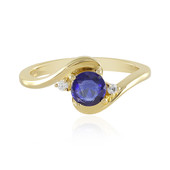
Pink
Tourmaline & Diamond 9K Yellow Gold
Ring |
|
While the 20th century has seen Tourmaline come
into its own, it was also known in classical
times. In the 3rd century, Theophrastus (the
successor of Aristotle's school of philosophy)
called it 'lyngourion', and a Green Tourmaline
seal stone sporting the likeness of Alexander the Great dating to the same period is
believed to be the oldest known example.
Believing it to possess arcane influence, the
Romans apparently used Tourmaline in
animal-themed carved brooches. Coming into the
business while Tourmaline was still riding the
wave of popularity following Paraíba's 1989
debut and the discovery of one of the world's
most significant Tourmaline deposits in Nigeria
(circa 1998), I never really understood why some
authors would describe Tourmaline as "confused",
"misunderstood" or "historically maligned". For
me, it was always an important gem, both
aesthetically and commercially, and the first
three gems I ever purchased were Tourmalines (a
pink and green for friends and a lovely bicolour
for my mother).
Today Rubellite, along with Paraíba Tourmaline,
Chrome Tourmaline and Indicolite, are the rarest
and most valuable
Tourmalines. Rubellite is a lustrous transparent
gemstone that comes in red, strong purplish-red
and slight purplish-red. As stated previously,
pure reds with virtually no secondary purples
are exceptionally scarce and demand a premium.
While sometimes attractive, Rubellite with
visible brownish mahogany tints will be priced
cheaper. As usual, colour preferences in gems
are subjective, but you should be aware of the
marketplace dynamics. For Rubellite, heed the
old Goldilocks' maxim (click
here for more);
look for a happy medium that is as intense as
possible, but not too dark or too light.
In Rubellite, the trace element that lends its
delightful purplish-reds is manganese, but this
is a double-edged sword. More manganese gives
Rubellite a deeper tone and saturation, but also
increases the prevalence of inclusions. This is
why a clean intensely coloured Rubellite,
especially over 4 carats, is a veritable
scarcity. Taking this into account, Rubellite,
like Emerald, is classed as a Type III gemstone
(click here for more), meaning they typically
grow with many inclusions in nature. Most Rubellite is going to have eye-visible
inclusions, although this can vary a little from
locale to locale. Like all Tourmaline, Rubellite
can be a challenging gem for the lapidary due to
areas of internal tension inside Tourmaline
crystals and its inherent pleochroism (dichroism).
On the other hand, the two-colours of
Rubellite's crystals are less of a concern for
the lapidary than with Green Tourmaline and
Indicolite because the secondary colour isn't as
dark. Expect a variety of shapes and cuts for
this gem, such as ovals, pears and rounds, often with
extra pavilion facets to scintillate its
colourful brilliance. As usual, look for a good
shape and overall appearance.
Rubellite & Pink Tourmaline Colours
Origin is important for Rubellite and with only
four modern commercially significant deposits,
it's an easy thing to get a handle on. Brazil's
Cruzeiro Mine, located in São José da Safira in
Minas Gerais, was an important deposit in the
late seventies and eighties, but it was the
Tourmaline deposit's unearthed near the city of
Ibadan in Nigeria, West Africa from 1998 onwards
that really turned heads. Nigeria is noted for
yielding extremely fine Rubellite (as well as
other Tourmalines), sometimes in larger sizes
than usual. The next were the deposits near the
town of Betafo, located in Madagascar's central
highlands, which were discovered around 2005.
This deposit divides opinion, with some viewing
its output as globally insignificant and tainted
by too many brownish chocolates, and others
praising its more ruby-like specimens. The most
recent, albeit short-lived discovery, is from
Shimoyo (also spelt Chimoio) in Mozambqiue's
Manica Province. Only in operation from around
January to April 2008, this deposit's Rubellite
is characterised by an unusually high
'eye-clean' clarity and a 'classic' colour, with
very little secondary brownish tints. It is no
surprise that its reported output of only 10
kilogrammes was quickly snapped up by big rough
buyers.
Incredibly scarce, particularly when eye-clean,
Rubellite is one of those rare gemstones whose
opulent purplish-reds demand a place in your
gemstone entourage. But don't just take my word
for it. Friend, gem dealer, lapidary and
colourful raconteur, Brazilian Tony Diniz, sums
Rubellite up as follows: "There is Ruby red
and then there's Rubellite red. Almost every
jewellery lover has a Ruby, but with only a
handful of deposits, owning Rubellite is the
hallmark of a true gemstone romantic".
 |
Pink Tourmaline
One common question is what is the
difference between Pink Tourmaline and Rubellite?
After recognising that red and pink are
technically the same colour, Rubellite is
distinguished from Pink Tourmaline by its deeper
tone (lightness or darkness of a colour) and
greater saturation (strength of a colour).
Confused? To help, I've included a nifty colour
chart to show you where Pink Tourmaline ends and
Rubellite begins. One thing to remember with
Pink Tourmaline is that is usually less included
than Rubellite. Classed as a Type II gemstone,
Pink Tourmaline typically grows with some minor
inclusions in nature which may be eye-visible.
Despite this, most Pink Tourmaline is eye-clean
and I favour intense medium-toned examples with
this clarity. Historically, carved pink and red
Tourmalines were a big hit in China. The Dowager
Empress was not only enamoured with Jade, she
also loved Tourmaline so much that she
reportedly purchased almost a tonne of
Californian Tourmaline, an important deposit in
the late nineteenth and early twentieth
centuries.
 |
Bi Colour Tourmaline
Mentioned as a gemmological curiosity in
early 20th century texts, by the seventies Bi
Colour Tourmaline was coveted as one of the
rarest of all bicolour gems. Typically showing
either a green and pink split or a brown and
green split, combinations of apricot, blue,
bluish-green, colourless, green and pink are
also possible, sometimes with more than two
colours in a single gem. Bi Colour Tourmaline's
unique colours are down to environmental changes
during formation due to the depletion of the
trace elements that lend Tourmaline its plethora
of colours. The problem with these disturbances
during the gem's formation is that it results in
inclusions that are usually eye visible.
Eye-clean Bi Colour Tourmalines with the
signature pink/green split are rarer than rare,
and are priced accordingly. Deliberately cut to
accentuate its split personality, any bicolour
gem should ideally show a fairly even split of
colour. Don't confuse Bi Colour Tourmaline with
Watermelon Tourmaline; this gem has a pink inner
and green outer, just like the fruit. |
|